From E-Waste to Strategic Resource: Rethinking Sources of Strategic Critical Materials
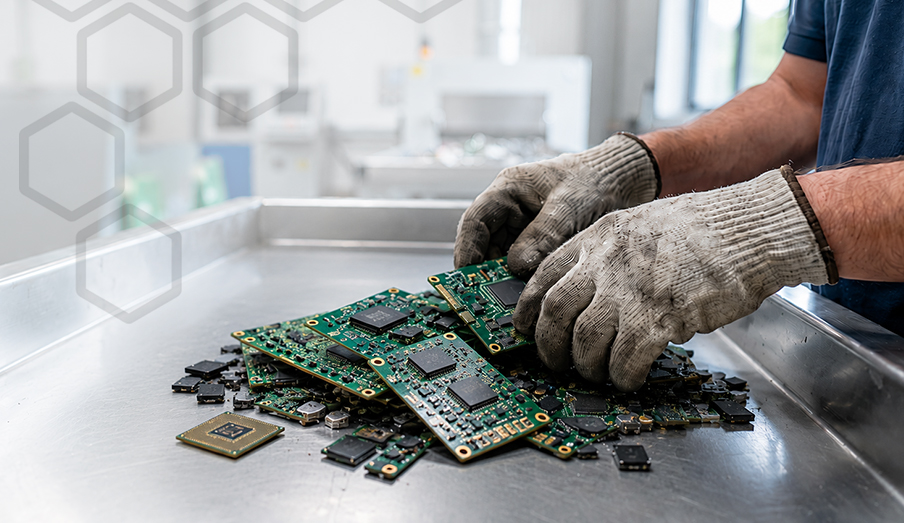
We tend to think of electronic waste as an endpoint: a retired server, failed circuit board, obsolete electronics, or industrial equipment that has reached the end of its useful life.
But what if the end of one product lifecycle could be the beginning of a domestic supply chain?
E-waste contains Strategic Critical Materials already inside our borders; materials important to semiconductors, communications, advanced electronics, energy technologies, and defense applications.
The concept of urban mining changes the way we look at this resource. Instead of treating obsolete electronics strictly as waste, we can view them as above-ground inventories of strategically valuable materials.
Importantly, opening an urban mine does not have to mean building a recovery system around a single material.
Gallium, for example, is one priority among many Strategic Critical Materials that can become increasingly important as defense requirements, technologies, markets, and supply-chain vulnerabilities change. A flexible recovery platform that begins by targeting one material can also create access to a broader material inventory and adapt as priorities evolve.
That creates a simple approach to a complex problem.
Urban mining becomes more than recycling. It becomes domestic supply-chain infrastructure.
The advantages are significant:
-
- Supply-chain resilience. Domestic recovery can diversify sources of Strategic Critical Materials and reduce exposure to disruptions in global supply.
- Greater resource productivity. Materials already extracted, refined, and incorporated into products can be recovered for another productive use.
- Reduced waste and environmental impact. More effective recovery can divert valuable materials from disposal while reducing the need for additional virgin resource extraction.
- Economic opportunity. Materials once treated primarily as a disposal challenge can become inputs to domestic processing, manufacturing and technology supply chains.
- Strategic flexibility. Infrastructure developed to recover one priority material can provide access to others as technology, markets and national-security requirements evolve.
This is the circular economy in practical terms: not simply a sustainability concept, but a way to make better use of resources we already have while strengthening domestic supply chains.
At BESI, our Strategic Critical Materials work is focused on applied technology: practical, scalable recovery approaches designed for real operating environments. Our methodology efficiently removes the surrounding matrix without diluting the target material, with a recovery objective exceeding 98 percent.
Sometimes big problems need small-scale solutions. Distributed, modular recovery can bring processing closer to material sources, build domestic capacity incrementally, and create infrastructure capable of responding to tomorrow’s strategic material priorities – not only today’s.
The next domestic source of Strategic Critical Materials may not be underground. It may already be sitting in the equipment and electronics around us.
BESI welcomes conversations with government, defense, industry, research, and technology partners interested in advancing practical Strategic Critical Materials recovery and building more resilient domestic supply chains. Click here to get in touch and learn more.